

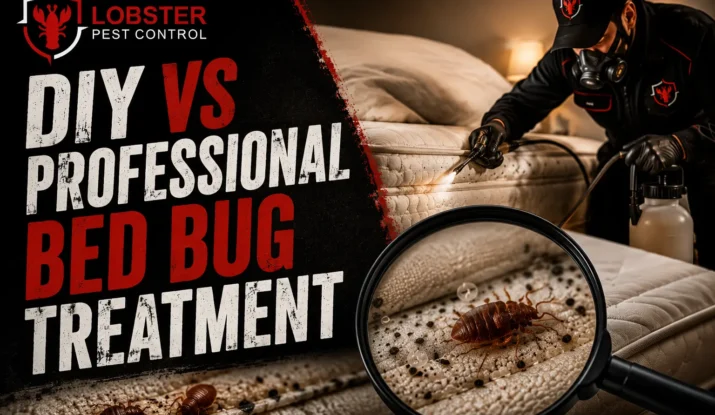
Bed bugs are one of the hardest pests to eliminate on your own. Before you spend money on store-bought sprays, here’s an honest comparison of DIY bed bug treatment versus professional bed bug treatment — why so many DIY attempts fail, what’s actually happening when bed bugs “come back,” and how to know which approach is right for your situation.
Why Bed Bugs Are So Hard to Eliminate
Bed bugs aren’t like most household pests. They’re flat, fast-moving, and nocturnal, which means most people never actually see the bugs themselves — only the bites, blood spots on sheets, or dark fecal marks along mattress seams. A single female can lay hundreds of eggs over her lifetime, and those eggs are resistant to many surface-level treatments. This combination — hiding ability, rapid reproduction, and resistance to casual treatment — is exactly why bed bugs have a reputation for being one of the most stubborn pests to fully clear.
Where Bed Bugs Actually Hide
Understanding hiding spots explains why DIY sprays so often fail:
- Mattress seams and box spring frames — their most common daytime hiding spot
- Headboards and bed frame joints — especially where wood meets wood
- Behind wall outlets and switch plates — bugs travel through wall cavities
- Furniture joints — sofas, armchairs, and drawer units near sleeping areas
- Carpet edges and skirting boards — particularly in corners of the room
- Luggage, clothing, and soft furnishings — a common way infestations spread between rooms or properties
A spray applied only to the mattress surface misses the vast majority of an actual colony, since most bugs and eggs are tucked into cracks and voids the spray never reaches. Our full Bed Bugs Treatment page covers our inspection and treatment process in more detail.
Why DIY Bed Bug Treatment Often Fails
Store-bought products usually only kill bugs on direct contact, missing eggs and hidden clusters entirely. This means infestations often return within weeks, sometimes appearing worse than before — not because the problem got worse, but because surviving bugs simply relocate deeper into the property to avoid the treated areas, making the next attempt even harder.
There’s also a resistance factor: some bed bug populations have developed reduced sensitivity to common over-the-counter insecticides, meaning sprays that worked a decade ago may be far less effective today.
What DIY Methods Can (and Can’t) Do
Can help with:
- Reducing surface-level activity temporarily
- Washing and heat-drying fabrics (bed bugs and eggs die at high heat, generally above 50°C sustained for at least 30 minutes)
- Vacuuming visible bugs and eggs from mattress seams and carpet edges
- Encasing mattresses and box springs in bed bug-proof covers to trap and starve any remaining bugs
Can’t do:
- Reach eggs hidden in cracks, seams, wall voids, and furniture joints
- Guarantee full colony elimination in a single treatment
- Prevent re-infestation from neighboring units in apartment buildings
- Treat the source if bugs have already spread beyond the bedroom
Why Professional Treatment Works Better
Professional bed bug treatment typically combines several methods that address the full lifecycle of the infestation, not just visible bugs:
- Thorough inspection — identifying every hiding spot, not just visible activity, often using flashlights and specialized detection tools
- Targeted chemical or heat treatment — reaching areas DIY sprays can’t, including wall voids and furniture joints
- Follow-up visits — confirming eggs haven’t hatched into a new generation, typically scheduled 1-2 weeks after initial treatment
- Prevention guidance — especially important in apartment buildings where bed bugs can travel between units through shared walls or hallways
Heat treatment in particular has become popular because it can penetrate areas chemical sprays can’t reach, killing bugs and eggs at every life stage in a single session — though it requires specialized equipment and is typically more expensive than chemical treatment. If budget is a factor in your decision, our Pest Control Cost in Dubai guide breaks down what typically drives bed bug treatment pricing.
Signs You Need Professional Help
- You’ve tried DIY sprays and bites are still happening
- You’re finding bugs in multiple rooms, not just the bedroom
- You live in a shared building where neighboring units may also be affected
- You’ve spotted rust-colored stains on sheets (a sign of an active, spreading infestation)
- You’ve noticed a sweet, musty odor in the room — a sign of a large, established colony
What to Expect From a Professional Visit
A typical professional treatment starts with an inspection to confirm bed bugs (as opposed to other biting insects, which are often mistaken for bed bugs), followed by a treatment plan tailored to the infestation size. Most cases require more than one visit, since a second treatment ensures any eggs that survived the first round are eliminated before they hatch. All licensed providers in Dubai operate under standards set by the Dubai Municipality Public Health Pest Control Section — worth confirming before booking any provider.
Bottom Line
DIY methods can reduce visible activity, but they rarely eliminate an established colony. If bites are recurring or you’re seeing bugs in more than one room, it’s time for a professional inspection rather than repeating ineffective treatments that may just be pushing the problem deeper into your home. Contact us to book an assessment.
Frequently Asked Questions
Can bed bugs go away on their own? No — bed bugs don’t leave on their own and will continue breeding until the infestation is treated at the source.
How long does professional bed bug treatment take? Most cases require an initial treatment plus one or two follow-up visits over 2–3 weeks to fully break the breeding cycle.
Do bed bugs spread between apartments? Yes, especially through shared walls, electrical outlets, and hallways in multi-unit buildings — which is why building-wide awareness matters.
Does heat treatment work better than chemical treatment? Heat treatment can reach hiding spots chemical sprays miss and kills all life stages in one session, but it’s typically more expensive and requires specialized equipment.
How do I know if it’s bed bugs and not another insect? Bed bug bites often appear in a line or cluster, and finding rust-colored stains on sheets or small dark spots along mattress seams is a stronger indicator than bites alone, since bites can resemble other insect bites.
Will I need to throw away my mattress? Not usually — professional treatment combined with a mattress encasement is typically enough, and full replacement is rarely necessary unless the mattress is severely damaged.