

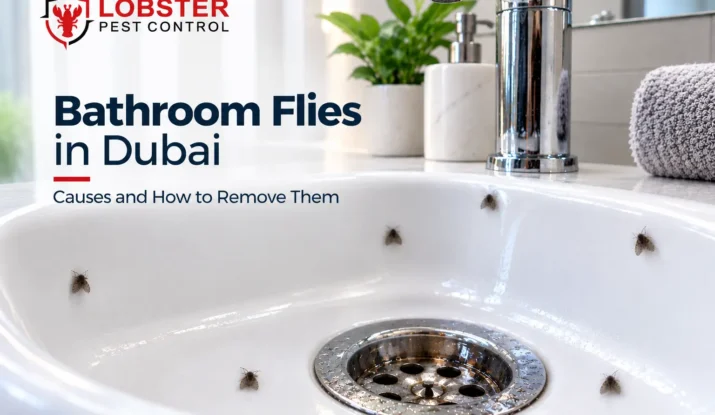
Bathroom Flies in Dubai: Causes and How to Remove Them
You walk into the bathroom, switch on the light, and a few tiny, fuzzy flies hop off the wall. You wipe them away, and the next evening they are back. If that sounds familiar, you are almost certainly dealing with bathroom flies, better known as drain flies. The good news is that they are harmless to most households and fixable once you know where they actually live. If cleaning the drain does not solve it, our fly control service in Dubai can help trace the source.
Quick answer: Small flies in the bathroom usually breed in the slimy film that builds up inside drains. University extension guides agree that removing that breeding film is the key to control, while scrubbing the drain with a pipe brush is the simplest fix. Spraying the adults or pouring bleach down the drain only gives short-term relief.
What Are Bathroom Flies?
Bathroom flies are tiny insects from the family Psychodidae. They go by many names: drain flies, moth flies, filter flies, sink flies and sewer flies. Wikipedia’s entry on Psychodidae explains that the “moth” name comes from their furry, moth-like bodies, and that the drain and sewer names come from the few species that live in plumbing.
In Arabic, drain flies are called ذبابة الصرف. A University of Mosul handout says it is sometimes also called ذبابة المجاري (sewer fly) and is usually linked to sewage drains. The Arabic site Mawdoo3 uses ذباب الحمّام (bathroom flies) for drain flies and advises scrubbing the pipes with a long brush, then calling local pest control if that does not work.
How to recognise a drain fly
UC IPM describes them as small, often dark flies with hairy wings that rest in a roof-like shape over the back. They are weak fliers that move in short hopping bursts, and their wing veins run in parallel lines, a pattern unique to this family. In size, UF/IFAS puts adult males at roughly 2.5 to 3 mm and females at about 4 to 4.5 mm. Clemson’s factsheet adds that they rest on walls near drains during the day and are most active in the evening.
Are sewer flies and drain flies the same thing?
Mostly, yes. A 2024 review in the Journal of Clinical Microbiology points out that “drain fly” and “sewer fly” were originally names for a few household-friendly species, such as Clogmia albipunctata, but people now use them for the whole family. So when someone says sewer flies or a sewer fly infestation, they usually mean the same fuzzy flies you see in the bathroom.
Why Do You Have Small Flies in Your Bathroom?
It comes down to one thing: a wet, organic film inside the drain.
- The drain slime. Ohio State Extension notes that eggs, larvae and pupae live in the bacterial slime that collects on the sides of drains and overflow pipes.
- The bathroom is the usual spot. UC IPM says bathroom drains are the most common development site in homes.
- They do not travel far. Because of their poor flying ability, the source is usually the nearest drain. Flies on the wall mean a drain close by.
- Moisture matters. UF/IFAS reports that females lay eggs on wet or moist surfaces and avoid dry ones.
- Heat speeds them up. The same UF/IFAS profile says the larval stage lasts about nine to 15 days at 21°C but can drop to as few as eight days at around 29.5°C. That is worth remembering in a warm city like Dubai.
It is not always the bathroom drain, though. UC IPM lists sump pumps, elevator pits and wet material under leaking pipes as other places moth flies have been found. Outdoors, Clemson notes they can breed under potted plants, in bird baths, in clogged gutters and under air conditioners.
Drain Fly Larvae and Life Cycle: Why They Come Back
Understanding the drain fly life cycle explains why one spray never fixes the problem.
- Eggs: egg masses of 15 to 40 are most common, and at about 21°C they hatch in under two days.
- Drain fly larvae: slender, pale and a little like mosquito larvae, with a breathing siphon. UF/IFAS says larvae can trap air bubbles to cope with low oxygen, and the Journal of Clinical Microbiology review cites a lab observation that larvae of one common bathroom species lasted only about 24 hours submerged before dying without surface air. That is why simply flushing water down the drain does not clear them.
- Pupae: 24 to 48 hours before adults emerge.
- Adults: live around two weeks, with old flies dying as new ones emerge.
Put together, the full cycle can finish in as little as eight days or take up to 24, depending on temperature. Kill the adults and a new batch is already growing inside the pipe.
Are Bathroom Flies Harmful?
For most homes they are a nuisance rather than a danger, though the sources are not identical on the details.
- They do not bite. UF/IFAS states that Psychoda drain flies are non-biting and not known to transmit any pathogens, but that very large numbers can cause breathing irritation from the fine scales that fall off their bodies.
- UC IPM adds that because they develop in decaying matter, they could carry microbes into places where cleanliness really matters, such as food preparation areas, and that dead flies can break down into allergens.
- A 2020 study in Emerging Infectious Diseases examined a German hospital where moth flies bred in the sewage system, and found that about 41% of the flies tested carried multidrug-resistant bacteria. That was a hospital setting with extensive drain biofilm, not an ordinary home, but it shows why food businesses and clinics should take drain flies seriously.
You may also have read frightening stories about larvae living inside the human body. The same clinical microbiology review concluded that the biology of these larvae makes survival in the intestinal or urinary tract unlikely, and that most reported cases are probably incidental findings. In everyday terms: no need to panic, but do clean the drain.
How to Get Rid of Bathroom Flies: Step by Step
This is the routine that the university guides point toward. If you are wondering how to get rid of small flies in the bathroom or how to remove small flies from the bathroom for good, work through it in order.
Step 1: Find the drain they are breeding in
Put clear tape over the suspect drain for 24 hours. UF/IFAS recommends checking the tape afterward for trapped flies. Another option from UC IPM is to coat the inside of a cup with Vaseline or vegetable oil and turn it upside down over the drain. Check every drain in the room, since more than one can be infested.
Step 2: Scrape out the slime
UC IPM suggests using a hard-bristle brush, snaking the drain first if it drains slowly, and removing and cleaning the J-trap under a sink. UF/IFAS agrees that manually removing the organic material is the simplest control method.
Step 3: Use an enzyme or bacterial drain cleaner
Ohio State Extension says the best cleaning approach is an enzyme product that breaks the sticky bond between the pipe and the scum. Penn State Extension describes bacteria- or enzyme-based products that are poured around the drain lip or applied as foam. UC IPM adds that regular use of an enzymatic cleaner may help prevent the buildup returning.
Step 4: Rinse well
After cleaning, run water to make sure the drain flows freely. UF/IFAS also suggests pouring boiling water afterward to loosen anything the brush missed. Use hot water carefully: Tom’s Guide suggests very hot but not boiling water for bathroom sinks and showers to protect the plumbing, so check what your pipes can handle.
Step 5: Never mix bleach with a caustic cleaner
Ohio State Extension warns that caustic drain cleaners must never be followed with bleach because chlorine gas can form. If you used one, do not add bleach on top.
Step 6: Deal with the adults last
Clemson notes that any aerosol or spray insecticide will kill adults, but long-term control needs the breeding site dealt with. A sewer fly killer spray is therefore a clean-up tool, not a cure.
What Does Not Work
- Bleach and boiling water alone. UC IPM calls this a common misconception, since neither removes the organic film. Ohio State adds that drain fly larvae are surprisingly resistant to bleach, and pest-control company Western Pest Services says bleach can even make a fly problem worse.
- Pouring insecticide down the drain. Ohio State warns that this can damage sewer and sanitation systems and the larvae seem to resist it.
- Bug bombs, fly paper and UV traps. According to Ohio State, these can catch or kill some adult flies but will not eliminate an infestation.
When It Is More Than One Drain: Sewer Fly Infestation
If you see flies in large numbers, the problem may be bigger than a single bathroom. UC IPM says very large numbers probably point to a development site larger than a few indoor drains. Possible causes include broken pipes in wall voids or under slabs, a hidden leak, or flies drifting in from an outside source such as a sewage facility.
For outside sources, UC IPM recommends exclusion: screen every window and vent, repair torn screens, and keep exterior lights away from doors. And Clemson suggests consulting a pest control operator or a plumber if control is difficult, because broken pipes or moisture problems can be hard to find yourself. Homeowners describe the same pattern: one parent on a Mumsnet thread said the flies only disappeared after a cracked drain pipe turned up during a kitchen floor replacement. That is one person’s account, not research, but it matches what the extension guides warn about. In Dubai, our pest control team can inspect drains and other likely breeding areas, and you can read more guides on our pest control blog.
Restaurants, kitchens and commercial spaces
In commercial buildings, UC IPM lists floor drains, grease traps, mop tubs and evaporation pans under appliances as typical breeding spots. Western Pest Services recommends biodegradable or enzyme-based drain cleaners and regular drain maintenance, and notes that a clean drain area also discourages cockroaches that lay eggs there. If cockroaches are also showing up, see our cockroach control service and our guide to DIY vs professional cockroach treatment.
How to Keep Bathroom Flies From Coming Back
- Clean drains regularly with a brush and an enzyme cleaner, including shower, sink, floor and overflow openings.
- Fix leaks and dry out damp spots, because females avoid laying eggs on dry surfaces.
- Flush water down rarely used drains, such as in a guest bathroom. Texas A&M AgriLife specialist Wizzie Brown recommends flushing water regularly down drains that are not used much.
- Empty and clean garbage bins, check for wet lint under the washing machine, and empty standing water under plant pots, as Ohio State Extension advises.
- Check air-conditioner drip trays and outdoor drains, since moth flies also breed under air conditioners and in clogged gutters.
- Follow a seasonal routine. Our season-by-season home pest control checklist for Dubai shows what to inspect and when.
How Lobster Pest Control Handles Bathroom Flies in Dubai
Here is how our fly control service works when bathroom or drain flies are the problem:
- Inspection first. A technician looks for the breeding source, including drains, kitchens and garbage areas. This matters most, because UC IPM says the presence of adults near a drain is a clear sign that drain is a development site.
- A plan that fits the problem. A single bathroom with a few flies needs a different approach from a building with several infested drains or a commercial kitchen.
- Targeted treatment for the flies. Depending on the case, this can include residual spraying on resting areas, fly baits and UV traps, or fogging and misting for larger spaces. Keep in mind that flying-insect sprays only knock down active adults and do not kill the larvae, so treatment works best alongside drain cleaning.
- Prevention advice and follow-up. We give hygiene recommendations, such as the drain-cleaning routine above, and follow-up inspections to confirm the flies have not returned.
Honest expectation: no spray replaces cleaning the drain itself. If the inspection points to a hidden leak or damaged pipe, a plumber may need to fix it too, which Clemson also suggests when control proves difficult.
Need Help With Bathroom Flies in Dubai?
If you have cleaned the drains and the flies keep returning, the source may be hidden in the plumbing. Our fly control service starts with an inspection that looks for breeding sites such as drains, kitchens and garbage areas. You can check our service areas, read about pest control costs in Dubai, then contact us, call +971 58 610 2018 or message us on WhatsApp.
Frequently Asked Questions About Bathroom Flies
Are bathroom flies the same as drain flies?
Yes, in most homes. Clemson lists moth flies, drain flies, filter flies and sewer flies as common names for the same family.
Why do small flies keep coming back after I use bleach?
Bleach does not strip away the slime layer where eggs and larvae live. UC IPM explains that boiling water and bleach do not remove the organic film, so they give short-term control at best.
How long do drain flies live?
Adults live roughly two weeks, though UF/IFAS reports that females that have not laid eggs can survive up to seven days. Sources differ because lifespans vary by species and temperature.
Do bathroom flies bite?
No. Clemson confirms moth flies do not bite.
Can drain flies come up through the toilet or shower?
Possibly. The Emerging Infectious Diseases hospital study reported that older larvae can move on and get past the water barriers in showers, bathtubs and toilets. This is another reason to clean every drain in the room, not just one.
What are bathroom flies called in Arabic?
The Arabic names are ذبابة الصرف, also called ذبابة المجاري (sewer fly) in a University of Mosul handout, and ذباب الحمّام (bathroom flies) in an article on Mawdoo3.
Sources
- University of Florida IFAS Extension: Drain Fly, Psychoda spp.
- UC Statewide IPM Program: Moth or Drain Flies
- Ohio State University Extension: Drain Flies (Moth Flies), ENT-41
- Clemson Cooperative Extension: Moth Flies (Drain Flies), HGIC 2436
- Penn State Extension: Moth Flies in the Home
- Mathison et al., Journal of Clinical Microbiology (2024): Psychodid flies and their implicated role in human myiasis and pseudomyiasis
- Rupprecht et al., Emerging Infectious Diseases (2020): Spread of Multidrug-Resistant Bacteria by Moth Flies from Hospital Waste Water System
- Western Pest Services: Flies in Restaurant Kitchen Drains
- Wikipedia: Psychodidae
- Mawdoo3 (Arabic): How to get rid of bathroom flies
- University of Mosul, Environmental Science (Arabic insect handout)
- Tom’s Guide: How to get rid of drain flies
- Texas Standard: interview with Texas A&M AgriLife Extension insect specialist Wizzie Brown
- Mumsnet: Tiny flies help (homeowner anecdote, not research)
Published by the Lobster Pest Control team, Discovery Gardens, Dubai. General information only; for severe or recurring infestations, get an on-site inspection.