

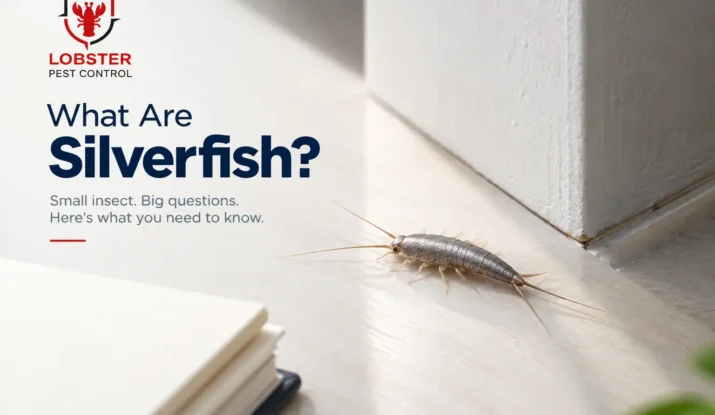
You open a wardrobe, lift a stack of old files, or flick on the bathroom light late at night, and something thin and silver streaks across the floor before you can react. It has a tapered body, long feelers and three little tails. If that sounds like what you saw, you were almost certainly looking at a silverfish. It is an unsettling sight, but the facts are calmer than the reputation: the Maine Department of Agriculture lists silverfish as harmless to people and pets, though they can damage paper, wallpaper, books and sometimes clothing. The real question is not whether they are dangerous. It is what they are doing to your belongings, and why they moved in. If the problem is bigger than a stray one or two, our pest control team in Dubai can inspect and help.
Quick answer: Silverfish are wingless, moisture-loving insects that hide in dark cracks by day and feed at night. University of California IPM says the best prevention is keeping basements, laundry rooms and bathrooms, especially shower stalls, clean and dry. Penn State Extension adds that no single method will remove them, so cutting food, water and hiding places has to be combined with treatment.
What Are Silverfish (and Why Are They Called Fish Moths)?
Silverfish belong to an old and simple group of insects. UF/IFAS describes the order they belong to, Zygentoma, as one of the simplest and least evolved in the insect world. Wikipedia notes that their ancestors, along with those of jumping bristletails, are considered among the earliest insects, appearing more than 400 million years ago. So the creature in your bathroom has a longer family history than almost anything else in the house.
You will hear several names for them. Penn State says silverfish and firebrats are often called bristletails, fishmoths, tasseltails or fringetails because of the three tail-like appendages at the back end. The “fish” part comes from how they look and move. Wikipedia explains the name as a mix of their silvery-grey colour and a wiggling, fish-like way of moving. Strictly speaking, the Entomological Society of America reserves the name “silverfish” for one species, Lepisma saccharina, but in everyday speech it covers several look-alikes.
In Arabic, the insect is usually called السمك الفضي or حشرة السمكة الفضية. Mawdoo3 describes it as a harmless household insect with a bluish-silver colour that lives in damp places.
How to recognise a silverfish
- Colour and size. UC IPM describes the common silverfish as shiny, silver or pearl grey, about half an inch long and sometimes up to three-quarters of an inch, which is roughly 1.3 to 1.9 cm.
- Body shape. Adults are slender, wingless and soft-bodied, with two long antennae and a body that tapers to three thin tail-like appendages. They have six legs, which matters when you compare them with centipedes later in this guide.
- Movement. Penn State says they move quickly, including sideways, and their flat bodies slip into narrow crevices.
- Young silverfish. Small nymphs under about 1/8 inch have no scales, while larger nymphs and adults do, so the very young ones look whitish rather than silver.
- Night shift. UF/IFAS says silverfish are nocturnal and rarely seen by day unless something disturbs their resting place.
Silverfish, firebrats and gray (long-tailed) silverfish
Not every fast silver-grey bug is the same species, and that affects how you control it.
- Firebrat. UC IPM says firebrats are mottled grey or brown and thrive in very warm, dry places, such as around ovens, heating units and hot water pipes. Penn State puts their preferred temperature above 90°F (about 32°C).
- Gray silverfish, also called long-tailed or paper silverfish. Wikipedia reports that this species (Ctenolepisma longicaudatum) has become a growing problem in European homes, especially newly built ones with a stable indoor climate. Pest-management company Insects Limited reports that it tolerates drier air, surviving at about 55% humidity where the common silverfish needs about 70%, and that its tails are almost as long as its body. That is a company’s technical blog, not peer-reviewed research, but University of Missouri Extension’s species table also lists the gray silverfish as tolerating a wide humidity range, unlike the common silverfish, which prefers high humidity.
We are not aware of a published species survey for Dubai homes, so we will not claim which one you have. If treatment keeps failing, confirming the species is a sensible next step. Norway’s public health institute also advises confirming suspected long-tailed silverfish by species identification.
Is it a silverfish or a house centipede?
The two get mixed up because both dash across bathroom floors. The easiest check is to count legs. A house centipede has 15 pairs of legs, with the last pair about twice as long as its body, while a silverfish has the six legs mentioned above. There is also a link between them. Colonial Pest Control notes that house centipedes feed on other household pests, including silverfish, and that frequent centipede sightings may mean you have a different pest underneath. Wikipedia lists earwigs, house centipedes and some spiders as known predators of silverfish.
Why Silverfish Do So Well in Dubai Homes
The short version is moisture. The University of Nebraska–Lincoln IPM manual says seeing silverfish, firebrats or booklice is an indicator of excessive humidity. Dubai has plenty of it. On 5 October 2026, Emirates 24|7 reported temperatures easing to the mid-30s while relative humidity climbed back to 90% across most major UAE cities. And it is not just a one-off: Gulf News, citing the National Centre of Meteorology, reported that Dubai’s mean maximum relative humidity between 1977 and 2018 was 76%.
Now compare that with what silverfish like. UF/IFAS says they are typically found in high-humidity environments at 22 to 27°C and often live in concealed, temperature-controlled spots such as bathrooms. UC IPM adds that silverfish prefer warm, damp places of roughly 71 to 90°F (about 22 to 32°C), and that at higher temperatures the relative humidity needs to be above 75%.
Our reading, not a study: an air-conditioned Dubai flat sits close to that comfortable temperature range, and humid outdoor air, wet bathrooms and cool closets give silverfish the moisture pockets they need. We have not seen research measuring this inside UAE homes, so treat it as a reasonable explanation rather than proven fact.
New or newly renovated properties deserve a special mention. UC IPM notes that silverfish can arrive in new buildings from surrounding wild areas, particularly as those areas dry out in summer, and can also be carried in on lumber and wallboard. The same page points out that freshly laid concrete and green lumber supply humidity, while wallpaper paste supplies food. If you have just finished a fit-out or moved into a new unit, that is worth keeping in mind.
Where Silverfish Hide in Your Home
- Bathrooms. Wikipedia lists attics, basements, bathtubs, sinks, kitchens, old books, classrooms and showers as typical urban spots. A smooth tub or basin is a trap: UC IPM says they cannot crawl up through a drain, but if they fall in, they cannot climb back out. In other words, the one in your bath did not come from the plumbing; Hunker makes the same point, noting they get stuck because they cannot climb smooth vertical surfaces.
- Wardrobes, bookcases and storage boxes. UC IPM says they choose bookcases, closets and places where books, clothing, starch or dry foods are available. The National Pesticide Information Center lists laundry rooms, closets and storage areas with boxes or books among their favourite spots.
- Behind skirting and around pipes. Penn State says they reach hiding spots through cracks under and behind baseboards, windows and door trim, and through holes where pipes pass through walls and floors.
- Kitchens and pantries. The Northeast IPM schools guide suggests checking damp boxes, fabric and warm, humid spots such as coffee makers and other kitchen equipment. UC IPM adds that they like dry foods such as cereals, flour, pasta and pet food.
- Outdoors. UF/IFAS notes they also live under rocks, in leaf litter, in caves and in ant nests, which is why they can drift indoors.
What Do Silverfish Eat? Do They Really Eat Clothes?
Mostly starch, sugar and anything with protein or glue in it, but the sources do not agree on every detail, so here is the honest summary.
- UF/IFAS says silverfish prefer starchy materials such as paper and wood, with the strongest preference for glazed paper, and they have been reported feeding on sugars, linen, silk, cotton, cereals, dried meat and dead insects. The same profile adds that they eat the glue behind wallpaper, curtains, carpets and book bindings.
- UC IPM says they have gut enzymes that digest cellulose, and they also eat the starch in clothing, household dust, dead insects and certain fungi.
- Penn State takes a slightly different view: it says that, despite the book-binding reputation, they actually prefer protein such as dried beef and dead insects, and that they do not feed on wool or other animal products.
- Wikipedia’s list of foods includes dandruff, hair, glue, paper, photos, sugar and coffee.
So do silverfish eat clothes? Starched cotton, linen and silk can be at risk, and the Minnesota Department of Agriculture lists cotton, linen, silk and rayon fabrics and starch in clothing among their foods. Wool is a different story. University of Missouri Extension says they usually avoid woollens, and Penn State says they do not feed on wool. So if your woollen jumpers have holes, our reading is that another fabric pest is the more likely culprit, and an inspection can sort that out. As for how they damage things, UC IPM says their weak jaws make them scrape rather than bite paper, and on paper and fabric the damage starts in one place and spreads as unconnected, irregular holes.
Silverfish Eggs and Life Cycle: Why They Are Hard to Shift
- Eggs. UC IPM says females lay eggs in crevices, on cloth, or buried in food or dust. Clutch sizes vary a lot between sources: UF/IFAS reports clutches of seven to twelve, with no more than 30 at a time, while Wikipedia says fewer than 60 at once and under 100 in a lifetime. Differences like these are normal, because species, temperature and food all play a part.
- Hatching. UC IPM gives about 19 to 32 days for silverfish eggs to hatch. UF/IFAS says hatching can take under 20 days at around 32°C but up to 40 days at about 22°C, so warmer rooms speed things up.
- Growing up. UC IPM says that above about 75°F (24°C) silverfish can mature in as little as 60 days, while below 50°F (10°C) it can take up to 500 days. UF/IFAS gives about one year from egg to adult as typical.
- Lifespan. UC IPM puts it at about three years, and says they keep moulting through 45 to 60 stages. UF/IFAS says up to four years in optimal conditions, and University of Maine Extension mentions lifespans of two to as many as eight years.
- Surviving without food. UF/IFAS says silverfish can go up to a year without food, and UF/IFAS Extension entomologist Dr Faith Oi advises people to expect a patient, slow battle.
- They gather in groups. UC IPM explains that silverfish release pheromones that draw them together in a central hiding place, where females often lay eggs. Find that hiding place and you find the heart of the problem.
Signs of a Silverfish Infestation
- Live sightings at night. If the object they hide under is moved, UC IPM says, they dart off to another secluded spot, so most people only see them when a light comes on.
- Tiny scales. UC IPM says scales around or beneath damaged items are a good sign, as they are delicate, dust-like and slightly shiny in the light.
- Damage and droppings. Medical News Today, citing the National Pest Management Association, lists feeding marks such as holes, notches or etching, yellow stains or scales, and tiny black pellets of droppings.
- A quick check with traps. UC IPM suggests cockroach sticky traps, or glass jars wrapped on the outside with masking tape so the insects climb in and cannot get out. Place them in corners and along edges.
One caution. UC IPM says silverfish can travel long distances looking for food, so pinpointing the source is often difficult.
Are Silverfish Harmful? Do They Bite or Fly?
For most households they are a nuisance to belongings rather than a danger to health.
- No bite, no wings. Medical News Today says silverfish cannot fly or bite, though they run very fast, and University of Missouri Extension confirms they are wingless and do not fly.
- No disease link. The Minnesota Department of Agriculture says silverfish and firebrats are primarily nuisances and are not associated with the spread of any disease. Wikipedia agrees that they contaminate food and cause other damage but do not transmit disease.
- Possible allergies. Medical News Today cites a 2015 review of indoor allergens and says the shed scales contain a protein called tropomyosin that can trigger reactions in some people, and that droppings may also cause allergy. If someone at home has asthma or dust allergies, that is one more reason to deal with an infestation early.
- Food contamination. The same article warns that silverfish can contaminate products such as flour, so keep pantry items sealed.
How to Get Rid of Silverfish: Step by Step
Set your expectations first. Utah State University Extension says complete control is difficult, and UC IPM says light infestations or the occasional insect can often be handled by reducing water sources and using physical control, with insecticides kept for larger infestations. Work through the steps in order.
Step 1: Confirm it and find where they gather
Use the sticky-trap or taped-jar method from the section above, and place several traps rather than one. Where the catches are highest is where to focus.
Step 2: Dry the place out
UC IPM recommends repairing plumbing leaks and drips, using dehumidifiers in closed spaces, and using fans to push humidity down to a level silverfish cannot tolerate. UF/IFAS agrees that reducing humidity may reduce the population. For bathrooms, Ideal Home’s pest experts suggest ventilating after showers, and using a dehumidifier if the room stays humid. If your bathroom has no window, running the extractor fan for a while after a shower is the practical version of that advice.
Step 3: Take away their food and clutter
UC IPM says household dust and debris are important food sources, so routine cleaning helps, as does periodically emptying closets, cabinets and storage containers. Penn State recommends airtight containers for cereals, flour, pasta and pet food, plus regular vacuuming of carpets, floors and upholstered furniture.
Step 4: Seal the hiding places
Penn State suggests closing cracks and holes with caulk, spackle or expanding foam, and UC IPM adds that holes or gaps around pipes and conduits should be patched. University of Missouri Extension also recommends caulking cracks around windows and doors that let silverfish in from outside.
Step 5: Use dry dust in cracks (only where it will stay dry)
Penn State describes diatomaceous earth and silica aerogel as desiccants, applied as a dust into cracks, crevices or wall voids, that work only while they stay dry and work best when water sources have been reduced. UC IPM adds that a thin layer is best, because a thick one becomes slippery, and that damp deposits cake and need re-treating. Medical News Today describes diatomaceous earth as safe for people and pets, but still follow the label and keep dust away from children and pets’ bowls.
Step 6: Use sprays or baits only for bigger problems
UC IPM says household sprays containing synergized pyrethrin or pyrethroids can kill silverfish on contact and leave some residual effect when small amounts are directed into cracks, crevices and dark hiding places. The same page warns that sprays must not get into sinks, drains, water or food, and that foggers are not recommended for silverfish.
Baits are a more mixed story. UC IPM says baits are not very successful because silverfish tend not to feed on them. Yet newer work points the other way for some products: Medical News Today summarises a study in which bait formulations containing 0.05% or 0.20% chlorfenapyr were the most effective at killing silverfish, and Norway’s public health institute says long-tailed silverfish can be controlled with toxic bait. A 2022 conference paper that trialled a cockroach bait on grey silverfish in four Dutch homes reported very few live silverfish at inspection after 21 days and none visible after 63 days. Note that one of its authors works for the bait’s manufacturer, Bayer, so treat it as encouraging rather than independent proof. The honest takeaway: bait choice and placement matter, which is one reason this step is best left to a licensed technician rather than trial and error with shop-bought products.
Step 7: Check again after two to three weeks
UC IPM says a properly applied insecticide should show results within a few weeks, and if there is no control after two or three weeks, the silverfish are probably coming from untreated, secluded harbourages. Go back to your trap map and look for the spots you missed.
Home Remedies: What the Evidence Actually Says
- Cedar, cinnamon, cloves, cucumber. These are everywhere online, including Arabic news sites such as Sada El Balad, which lists cedar oil and shavings, cinnamon, cucumber and cloves as natural repellents. Medical News Today labels the evidence for cedar, cinnamon and cloves as anecdotal. There is some lab work on one specific plant: UF/IFAS says essential oil from Japanese cedar (Cryptomeria japonica) has been shown to repel silverfish, and Wikipedia summarises the study as repelling 80% of silverfish on treated filter paper at a set concentration. That was concentrated oil under lab conditions, so it does not show that a cedar block in a wardrobe will clear an infestation. That last part is our interpretation.
- Boric acid. Mawdoo3 suggests boric acid traps in wardrobes, bookshelves and under sinks, and warns to keep it away from children, pets and food storage. Medical News Today says boric acid traps may help with small infestations but are harmful if swallowed. On the research side, UC IPM notes that several boric-acid dusts are ineffective against firebrats, so results depend on the product and the species.
- Sticky traps. Useful for monitoring, not as a cure. UC IPM recommends them for detecting and tracking infestations.
It is also worth hearing from people who have lived with this. On a Mumsnet housekeeping thread, one poster said they had been dealing with silverfish for over 20 years, another said diatomaceous earth gave little success for them and was messy, and a third said they used to see two or three a night by a cold, damp downstairs toilet. These are personal anecdotes, not research, but they fit the scientific picture: the damp spots and the persistence both match what the extension guides describe.
Protecting Books, Documents and Clothes
- The Northeast IPM schools guide advises storing food, paper and books in pest-proof containers when you cannot control humidity and temperature.
- UC IPM suggests moving books and papers around on shelves from time to time, since stacks give both food and shelter.
- Pest-control supplier Catchmaster advises keeping paper products off bathroom floors and out of damp cabinets.
- UF/IFAS notes that some people freeze an infested object to kill the insects, which can be an option for a small, valuable item like an old photo album, though check the item can tolerate it first.
- UF/IFAS identifies libraries and museums, where paper is plentiful, as common trouble spots, so family archives and school or office storage rooms deserve the same attention.
When to Call a Pest Control Professional
Consider calling for help if you are seeing silverfish week after week despite drying and cleaning, if you find damage on items you cannot replace, or if you suspect a hidden leak. UC IPM states that large populations are almost impossible to control unless dripping water and moist surfaces are removed, and Penn State notes that professional pest control companies have experience developing a management strategy for these insects.
Whoever you hire, here is what a sound visit should include, based on the extension guidance above:
- A proper inspection first. The 2022 bait paper stresses a thorough, detailed inspection to find the most promising spots, and the Minnesota Department of Agriculture says to concentrate on the source of the infestation.
- Treatment aimed at hiding places. UC IPM says to direct small amounts into cracks, crevices and dark hiding places rather than spraying open rooms.
- Moisture and storage advice for the leaks, ventilation gaps and storage habits that feed the problem.
- A follow-up check. The same paper suggests considering a repeat treatment, because some insects may be hiding in wall cavities or insulation that bait cannot reach at first.
Honest expectation: no spray replaces fixing the damp, and if the inspection points to a plumbing leak, a plumber may need to fix that too. If you want to know whether and how we can handle your particular property, contact us and we will tell you plainly.
How to Keep Silverfish From Coming Back
- Control humidity. Run extractor fans, fix drips and use a dehumidifier in closed rooms, as UC IPM recommends.
- Vacuum and dust regularly, since Penn State lists regular vacuuming as part of removing food sources.
- Seal gaps around pipes, skirting and door trim, as covered in Step 4.
- Store dry food in airtight containers. The National Pest Management Association recommends glass or plastic airtight containers.
- Inspect what you bring in. Norway’s public health institute reports that long-tailed silverfish hitch a ride in pallets, boxes and furniture, which is worth remembering when you move house or receive deliveries.
- Follow a seasonal routine. Our season-by-season home pest control checklist for Dubai shows what to inspect and when.
- Watch other damp-loving pests. A humid bathroom can attract more than one pest. If you also notice tiny flies around drains, read our guide to bathroom flies in Dubai, and if you see larger insects at night, see our cockroach control service and our guide to DIY vs professional cockroach treatment.
Need Help With Silverfish in Dubai?
If you have dried out the damp spots and the silverfish keep showing up, the hiding place may be inside walls, behind fittings or in stored boxes. An inspection is the best first step, because it shows where they gather and what is feeding them. You can check our service areas, read about pest control costs in Dubai, then contact us, call +971 58 610 2018 or message us on WhatsApp. You can also browse more guides on our pest control blog.
Frequently Asked Questions About Silverfish
Are silverfish harmful to humans or pets?
Not directly. The Maine Department of Agriculture lists them as harmless to humans and pets, though their scales and droppings may trigger allergies in some people.
Do silverfish bite?
No. Medical News Today says silverfish cannot bite, and UC IPM explains their jaws are too weak to bite, so they scrape the surface of paper instead.
Can silverfish fly?
No. University of Missouri Extension states they are wingless and do not fly. If you see a small flying insect near a drain, it is a different pest, and our guide to bathroom flies may help.
Why do I keep finding silverfish in my bathroom?
Because bathrooms are warm and damp. Wikipedia lists bathtubs, sinks and showers among the places they are found, and UC IPM specifically advises keeping bathrooms, especially shower stalls, clean and dry.
What attracts silverfish?
Moisture, starchy food and shelter. UC IPM lists cereals, flour, pasta, pet food, glued paper, book bindings and starch in clothing, and UF/IFAS adds that they favour humid, temperature-controlled indoor spaces.
How long do silverfish live?
Usually a few years. UC IPM says about three years, while University of Maine Extension mentions lifespans of two to as many as eight years. Sources differ because lifespan depends on species, temperature and food.
How many eggs do silverfish lay?
It varies by source and conditions. Wikipedia says fewer than 60 at once and fewer than 100 in a lifetime, while UC IPM gives an average clutch of 50, ranging from 1 to 200.
Is a silverfish the same as a house centipede?
No. House centipedes have 15 pairs of legs, whereas silverfish have six.
What are silverfish called in Arabic?
Commonly السمك الفضي or حشرة السمكة الفضية. Mawdoo3 uses السمك الفضي in its article on why they appear.
Are fish moths the same as silverfish?
Yes, it is another name. Penn State lists fishmoths among the common names for silverfish and firebrats. They are not true moths and do not fly.
Sources
- University of Florida IFAS Extension: Silverfish, Lepisma saccharina (EENY-705)
- UF/IFAS Extension blog: One Fish, Two Fish, Silverfish
- UC Statewide IPM Program: Silverfish and Firebrats (Pest Notes 7475)
- Penn State Extension: Bristletails (Silverfish and Firebrats)
- University of Missouri Extension: Silverfish and Firebrats (G7376)
- University of Maine Cooperative Extension: Silverfish and Firebrats
- Utah State University Extension: Silverfish and Firebrats
- University of Nebraska–Lincoln: IPM for Silverfish, Firebrats, and Booklice (2012)
- Northeastern IPM Center: Silverfish and Firebrats (School IPM)
- National Pesticide Information Center (Oregon State University): Silverfish and Firebrats
- Maine Department of Agriculture, Conservation and Forestry: Silverfish and Firebrat
- Minnesota Department of Agriculture: Silverfish and Firebrats IPM fact sheet
- Norwegian Institute of Public Health: Long-tailed silverfish
- Control of Ctenolepisma longicaudata (ICUP conference paper, 2022)
- Medical News Today: What silverfish are and how to get rid of them (medically reviewed)
- Wikipedia: Silverfish
- Wikipedia: Ctenolepisma longicaudatum
- Insects Limited: The Grey Silverfish (company blog)
- Emirates 24|7: UAE weather forecast, 5 October 2026
- Gulf News: UAE weather, sticky and dusty weather ahead
- DoMyOwn: House Centipedes (retailer guide)
- Colonial Pest Control: Meet the House Centipede (company article)
- Hunker: How to get rid of silverfish in the bathroom
- Ideal Home: How to get rid of silverfish
- Catchmaster: How do you get rid of silverfish in the bathroom? (company blog)
- Mawdoo3 (Arabic): Causes of silverfish appearance
- Sada El Balad (Arabic): Natural ways to get rid of silverfish
- Mumsnet: Silverfish thread (homeowner anecdotes, not research)
Published by the Lobster Pest Control team, Discovery Gardens, Dubai. This guide draws on university extension services, government agencies and peer-reviewed or medically reviewed sources, and it flags where sources disagree or where a statement is our own interpretation. General information only; for severe or recurring infestations, get an on-site inspection. Always follow product label directions.